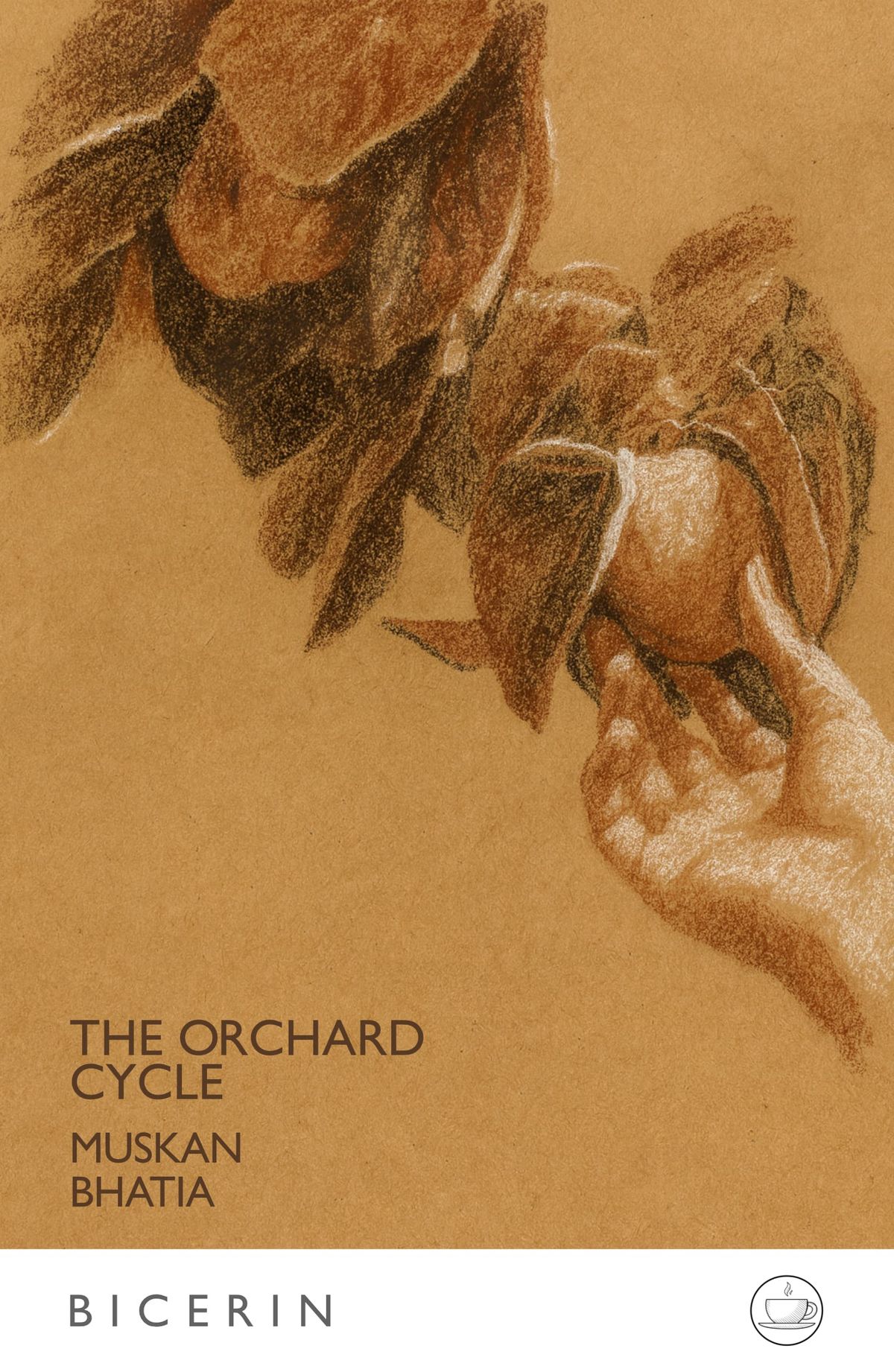
The Orchard Cycle
A poetry collection by Muskan Bhatia that explores emotion through fruit, seasons, and the quiet complexity of being human.

In this special period for Bicerin, we are very proud to present a new book by Muskan Bhatia!
In a literary world that often tries to organise, resolve, and soften what we feel, The Orchard Cycle moves in the opposite direction. It embraces contradiction. It lingers in the unfinished. It allows grief, joy, anger, and longing to exist without being corrected or simplified. Through the language of fruit and seasons, our hearts are moved so we can announce this to you, dear readers, through a podcast and Muskan's own words about her work.
I Didn’t Write This Book to Be Understood. I Wrote It
Because I Couldn’t Hold It Anymore.
There’s a cleaner version of this story.
In that version, I sit down with intent. I plan things out. I choose symbols carefully. I built something that looks like it knows what it’s doing. The Orchard Cycle arrives as a book.
That’s not what happened.
It started as an overflow.
Just too much feeling with nowhere to go.
Fragments. Lines written in passing. Half-thoughts that didn’t quite land but wouldn’t leave either. I wasn’t trying to be articulate. I wasn’t thinking about structure. I was just trying not to lie.
And honesty, real honesty, is messy. It doesn’t arrange itself nicely. It doesn’t care how it sounds.
This book came out of that.
The Orchard Wasn’t an Idea. It Was the Only Way I Could Say It
I didn’t choose fruit because it was pretty.
I chose it because it could hold contradictions without breaking.
Fruit already carries tension:
sweet and rotting,
soft but resisting,
something that feeds you and stains you at the same time.
It let me write emotion without flattening it.
A pomegranate could ache.
An orange could give everything and still keep something back.
A fig could stay unready and not apologise for it.
At some point, the orchard stopped being imagery. It became something closer to a body. Not a place you look at, but something you’re inside of. Something that remembers things you don’t have words for yet.
Part I: Before Anything Makes Sense

Orchard of Emotions isn’t reflective. It doesn’t look back.
It happens while things are still happening.
Nothing is settled. The language is still trying to catch up to the feeling. There’s no distance, no attempt to step back and explain.
If I were reading it as an editor, I’d probably call it unfiltered. Maybe even uneven.
But writing it, there was no other way.
The voice is exposed. It stumbles sometimes. It doesn’t always fully land. But that’s where it’s most honest.
What Time Does Quietly
The structure matters, but not neatly or technically.
It matters because of what time does.
The Turning of Seasons isn’t just a break in the book. It’s a shift in how things are seen. Something changes there. Less urgency, more awareness.
And The Late Harvest doesn’t repeat the earlier emotions. It comes back to them differently.
With distance.
With memory.
With a kind of truth that doesn’t need to be loud.
Part II: Holding Instead of Reaching
If the first half is instinct, the second is restraint.
Not suppression, just less grabbing.
These pieces don’t reach out in the same way. They don’t push. They sit. They wait. They let things be what they are.
The language softens, but it cuts deeper.
It becomes less about expressing everything and more about holding it without forcing it to resolve.
That shift feels like the real centre of the book.
What This Book Doesn’t Do
It doesn’t try to teach you anything.
It doesn’t wrap itself up neatly.
It doesn’t make emotion easier to understand.
That’s on purpose.
A lot of writing about feelings tries to explain them, clean them up, make them readable. But
most of the time, feelings aren’t like that. They’re messy. Contradictory. They don’t finish their own sentences.
This book leaves them like that.
What Stays
You don’t walk away with a message.
You walk away with something that lingers.
A line that comes back later.
An image that sticks longer than you expect.
Something that clicks quietly, without announcing itself.
There’s a line in the book: “I am not ready. Still green.”
As an editor, I can see how it runs through everything.
As a person, it just feels true.
Final Note
This isn’t a book you’re meant to admire from a distance.
You kind of have to step into it.
Read it slowly.
Let it feel uneven.
Come back to it when something in you shifts.
It doesn’t offer clarity.
It doesn’t offer closure.
Just this:
You’re allowed to be where you are.
Even if it doesn’t make sense yet.
Useful Links

 Muskan Bhatia
 Muskan Bhatia