Dante's Inferno: Canto XIII
Divine Comedy Series- Summary of Inferno, Canto 13. Where haunted trees scream, harpies snack on souls, and even your worst day starts to look manageable.
After a long break (deserved or not, I don't know), here we are at almost half of the inferno!
*Enjoy some dramatic music while reading this page to celebrate*
- Where we left: Entering the 2nd ring of the 7th Circle—the dreaded Wood of Suicides.
- When: Dawn on Saturday, April 9 (or, confusingly, March 26), 1300.
Canto 13 of the Inferno is one of the most haunting, poetic, and psychologically disturbing sections of the entire Divine Comedy; you are warned!
After the violence against neighbours (tyrants, murderers, pillagers) in the previous ring guarded by the Minotaur and the Centaurs (Canto XII), Dante and Virgil descend into an area dedicated to violence against oneself — the suicides and the squanderers.
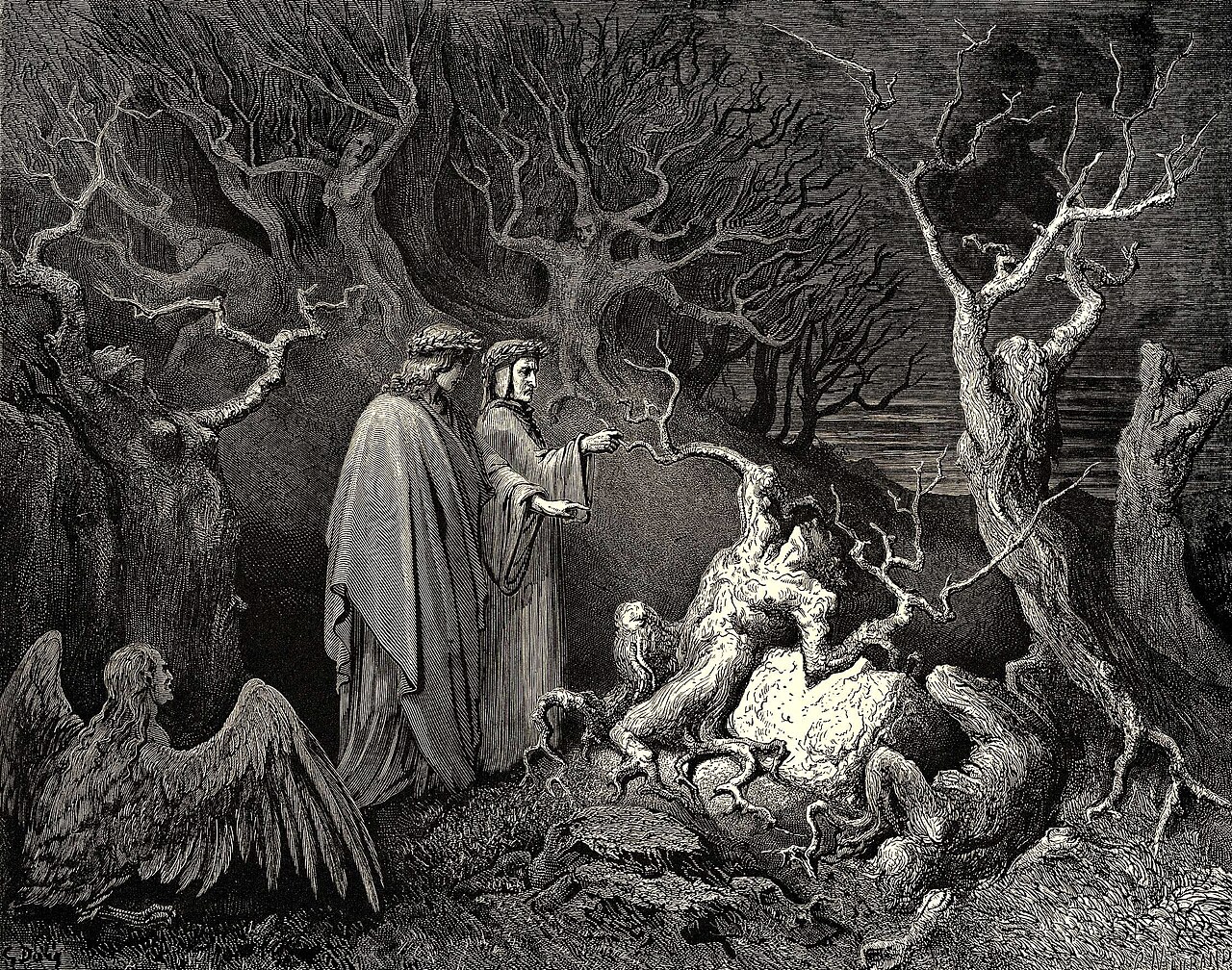
The Wood of Suicides
Unnatural, anti-Edenic forest
The second ring of the seventh circle houses the souls of humans who are characterised by negative identity. A metamorphosis has transformed them from humans into plants. Vegetable life alone.
Deliberately, an inverted, perverse version of the earthly paradise is created:
No green leaves → gnarled, thorny, poisonous trees.
No birds singing → only bird-women monsters from Greek mythology who feed on the leaves and create unbearable wailing.
No smooth paths → the ground is full of twisted roots and nodes that trap the feet.
This wood is the photographic negative of Eden: instead of life and harmony, everything here expresses sterility, pain, and impossibility of growth.
«No green leaves in that forest, only black;
no branches straight and smooth, but knotted, gnarled;
no fruits were there, but briers bearing poison.»
Line 4-6 (tr. Mandelbaum, Inferno: Canto 13)
The souls in this forest have thus been transformed into something other than what they were indeed, into what they were not:
They were humans; they are now plants.
They were forms of intellective life; now they are forms of vegetative life.
Even a tour guide like Virgin would say, “Nah, I’ll stay home.”
In the trees perch there are Harpies, half-woman, half-bird nightmares with wicked talons, squawking and screeching.
These Harpies feed on the leaves of the suicide trees, thereby causing pain to the sinners.
Why Harpies?
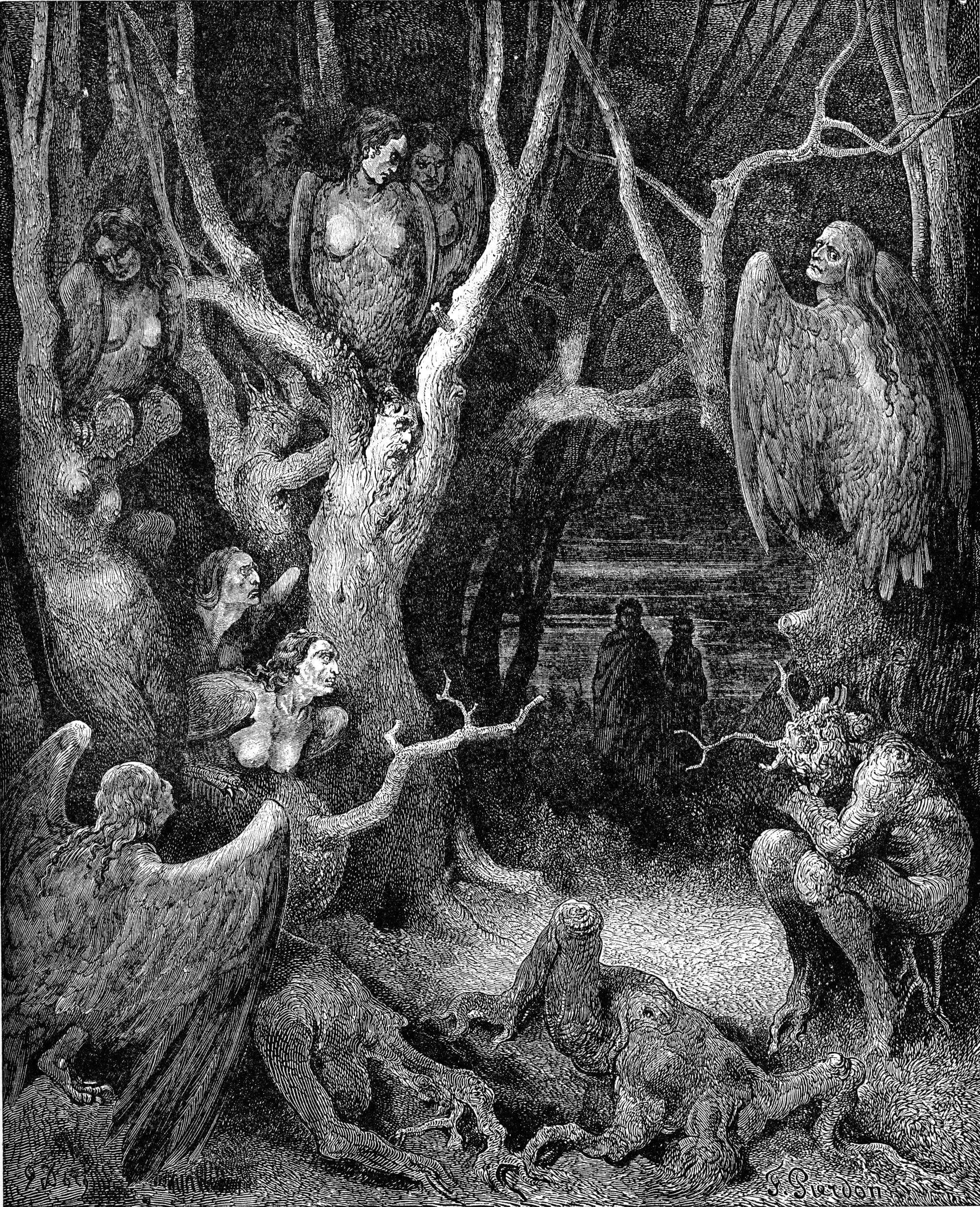
So what’s the mechanism exactly here? How can a creature with a woman’s face and a vulture’s appetite inflict real pain on an immaterial soul simply by eating salad?
Alighieri is deploying a piece of mythological sleight-of-hand to dramatise a profound theological truth. The “trees” aren’t costumes the souls are wearing; they are the souls, now locked into vegetative existence.
The apparent separation between eater and eaten is an illusion!
The Harpies aren’t hurting an external object; they’re tearing at the very substance of the suicide’s new, arboreal selfhood. It’s transubstantiation with teeth.
Having a hard time reading transubstantiation? You're not alone. I had to check the spelling 6 times 📖📖📖📖📖📖.
The Harpies embody the brutal negation of the divine human form they (these sinners) sought to destroy, acting as cruel guardians and tormentors in this desolate realm.
Hence the contrapasso!
Meeting Pier della Vigna
Dante, feeling like he’s in a haunted forest, hears voices which he thinks come from people hiding, and is frozen in confusion.
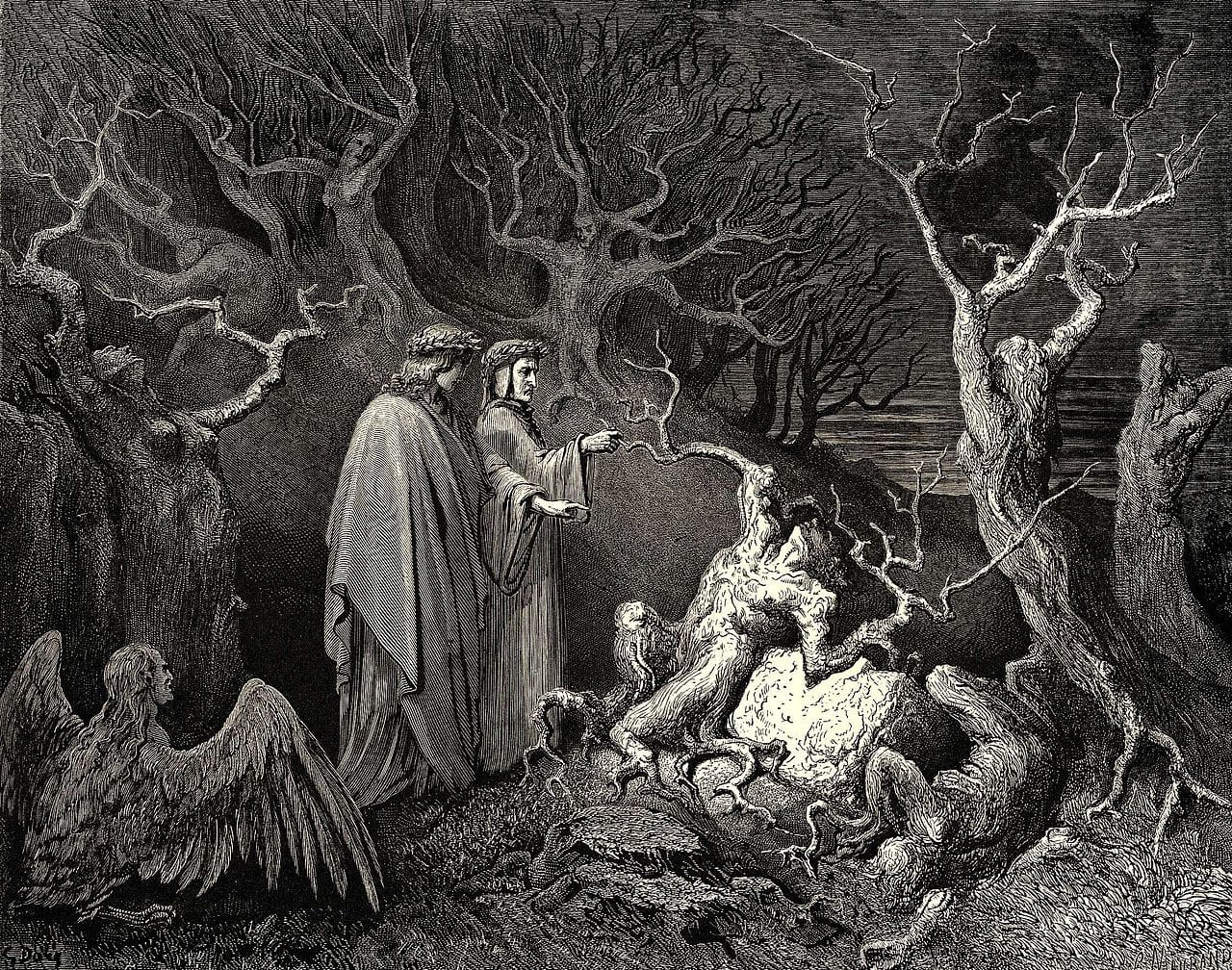
Virgil then tells him to snap a twig. Dante does and BAM, the tree starts bleeding black blood and shouting, “Ouch!”
Virgil explains that this cruel trick was only to teach Dante that in Hell, even trees can scream when you break them.
«Therefore my master said: “If you would tear
a little twig from any of these plants,
the thoughts you have will also be cut off.”
Then I stretched out my hand a little way
and from a great thornbush snapped off a branch,
at which its trunk cried out: “Why do you tear me?”»
Line 28-33 (tr. Mandelbaum, Inferno: Canto 13)
Then the tree speaks up—turns out it’s Pier della Vigna, once Frederick II’s (Holy Roman Emperor) right-hand man.
Virgil then speaks to the soul trapped in the tree, telling it that he had been forced to prompt Dante to make that gesture (snapping the branch), because only in this way would Dante understand what he himself had sung in the verses of the Aeneid.
Wowowowow okay okay, slow down, Virgil, a lot is happening here.
Which verse of the Aeneid is he talking about?
Virgil is referring to a famous passage from Book III of the Aeneid—the episode of Polydorus (lines ~22–48).
In that scene, Aeneas lands in Thrace and tries to pull up some plants to make a sacrifice. When he breaks a branch, it bleeds, and a voice cries out from the plant. The plant is actually the transformed body of Polydorus, a murdered Trojan prince whose blood has turned into a tree-like growth.
Done that, the Roman poet then invites the damned soul to reveal itself and tell its story, so that Dante, once back on Earth, could make amends for the harm suffered by restoring its fame.
What drives humans to suicide
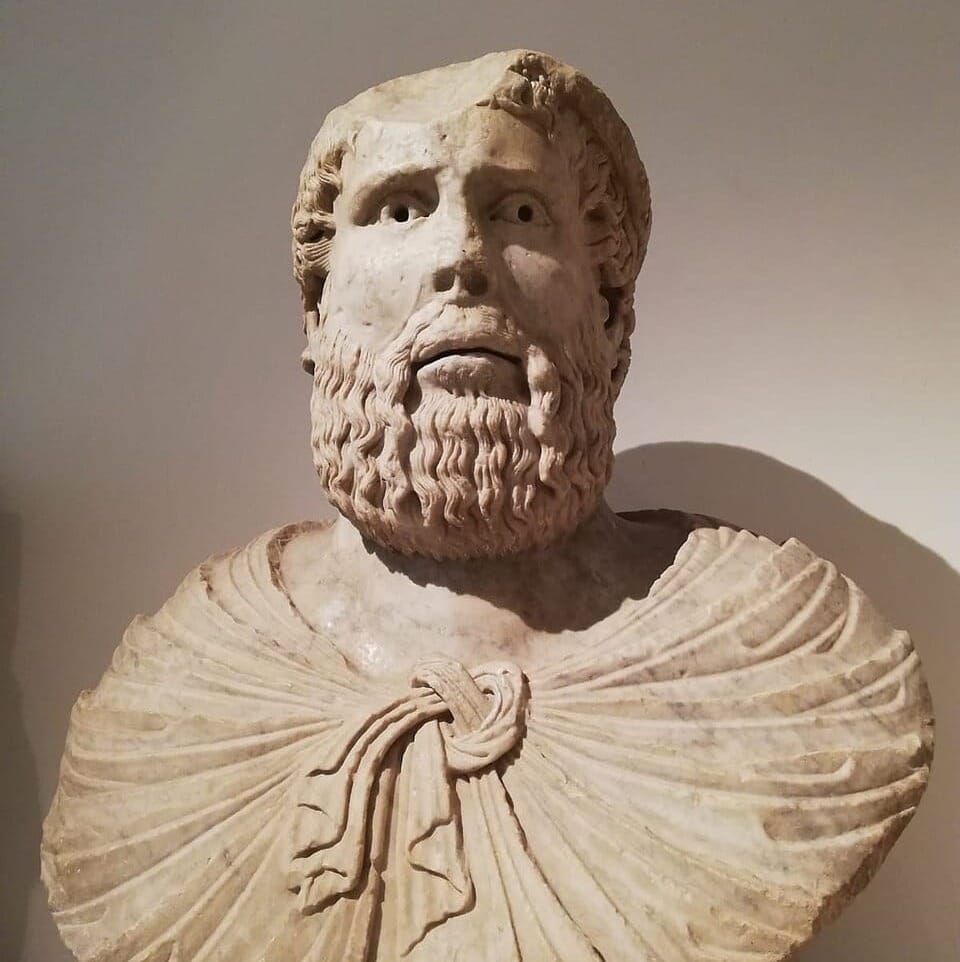
Born around 1190 in Capua to a modest family, Pier della Vigna rose through sheer intellect to become Frederick II’s most trusted advisor.
By the 1220s, he was the emperor’s chief notary, judge, and logothete .....essentially Frederick’s “other self”.
He drafted the famous Constitutions of Melfi, wrote the court’s most elegant and devastating letters, and held the keys to the empire’s secrets for nearly twenty years.
In 1249, as Frederick’s power waned, suspicion poisoned the court. Accused without solid proof of treason, bribery, and secret dealings with the Pope, Pier was arrested in February at Borgo San Donnino.
His eyes were burned out with a hot iron, and he was thrown into prison.
On the night of 24 April 1249, blind and broken, he asked the guards to let him stand near a tower window. Then he threw himself headfirst to his death.
It is not the case that to represent suicides is chosen a man of great moral stature. As always, the Tuscan poet touches with his profound consciousness the human soul.
Pier della Vigna (as far as we know it) is an innocent man, a righteous human, who commits this unrighteous act against himself.
How do souls who commit suicide transform?
Virgil pauses for a moment, then encourages Dante to ask the soul more questions. But Dante, too shaken to speak, leaves it to his guide. Virgil asks Pier della Vigna how the souls of suicides become trapped in the trees of the forest, and whether any ever escape.
Then he began again: “Imprisoned spirit,
so may this man do freely what you ask,
may it please you to tell us something more
of how the soul is bound into these knots;
and tell us, if you can, if any one
can ever find his freedom from these limbs.”
Line 85-90 (tr. Mandelbaum, Inferno: Canto 13)
The trunk sighs, and the voice returns.
When a soul separates from its body after suicide and appears before Minos (see canto V discussed earlier) , the infernal judge sends it to the Seventh Circle. There, it falls at random into the wood and takes root, growing into a wild, twisted plant. The Harpies feed on its leaves, causing constant pain.
On the Day of Judgment, the soul explains, they will reclaim their earthly bodies—but never wear them again. Instead, each will hang its body on its own tree, because it is not right to take back what one has violently cast away.
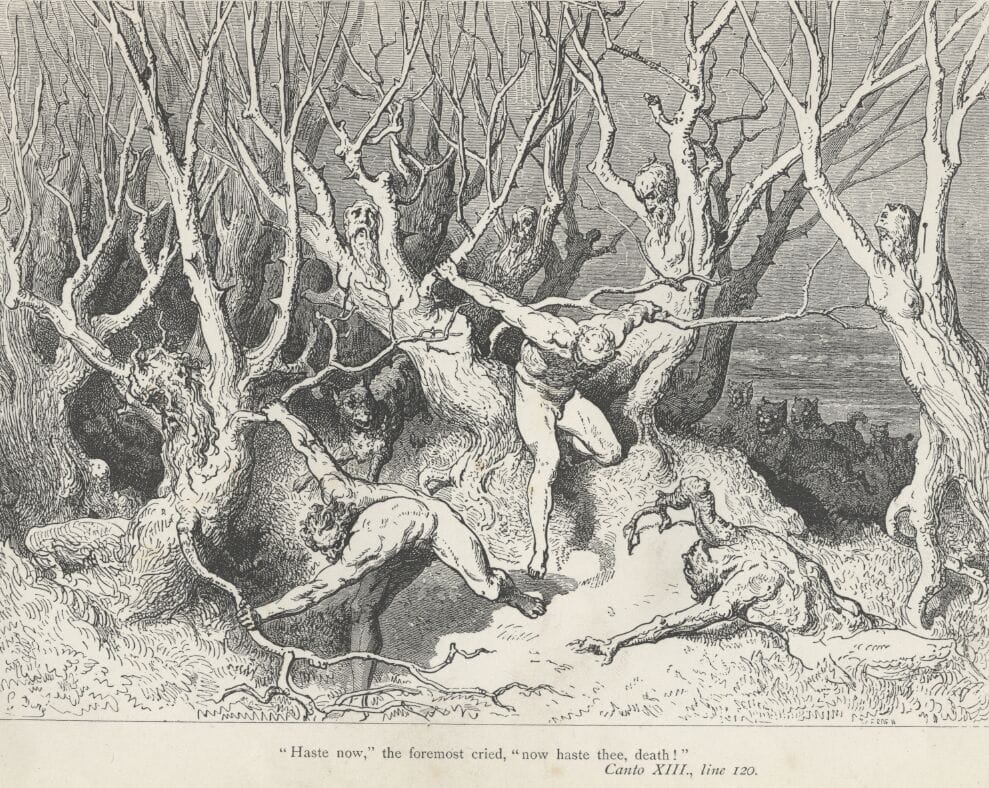
🏃 Scialacquatori on the Run
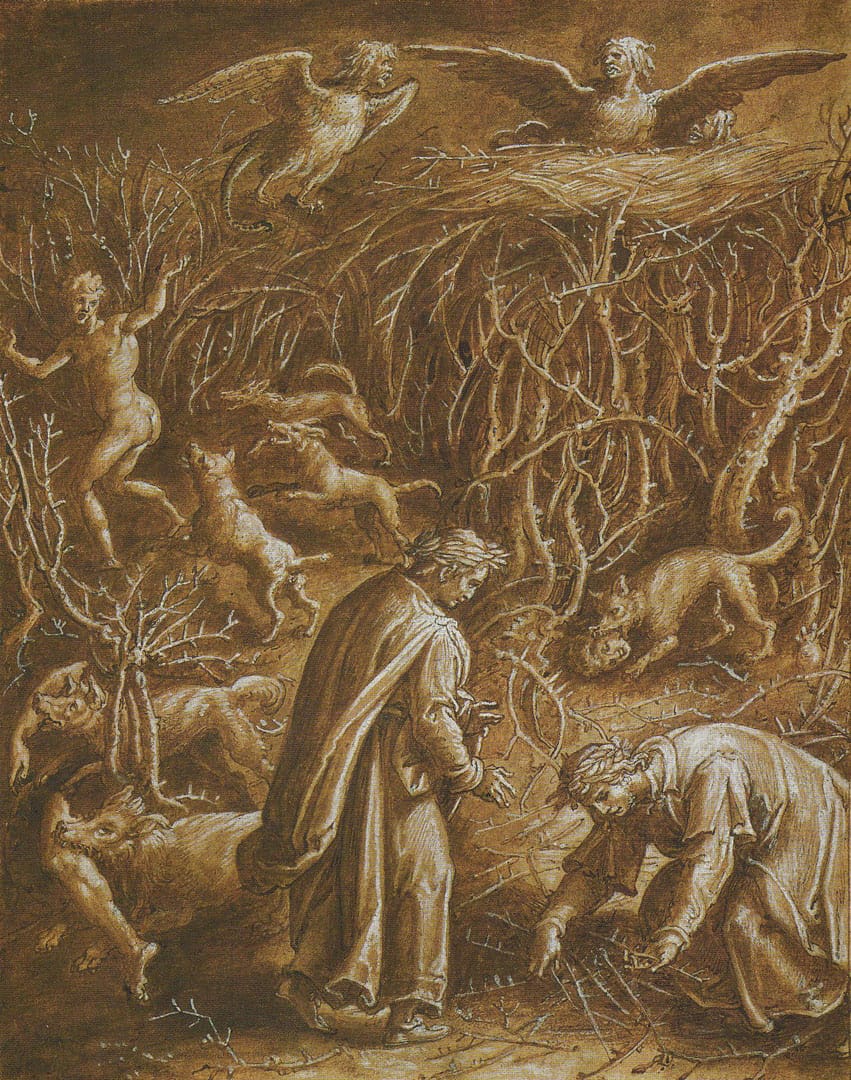
Dante and Virgil are still standing beside Pier della Vigna’s tree when they hear a sudden rumble in the forest like leaves rustling during a wild boar hunt.
Moments later, two damned souls burst through the undergrowth, naked and scratched, crashing through branches and brush.
Behind these two, black bitches filled the wood,
and they were just as eager and as swift
as greyhounds that have been let off their leash.
They set their teeth in him where he had crouched;
and, piece by piece, those dogs dismembered him
and carried off his miserable limbs.
Line 124-129 (tr. Mandelbaum, Inferno: Canto 13)
Scialaquatori means "spendthrifts/squanderer"
The one in front, Lano da Siena, runs faster, while the one behind—Iacopo da Sant’Andrea—lags behind and tries to hide behind a low bush. But he is quickly overtaken by a pack of black hounds, which tear both him and the shrub to pieces, carrying off his mangled remains.
Both (Lano and Jacopo) were very well-known spendthrifts in Siena and Padua, using public money as their own without any regard for the citizens' interests.
So, as these sinners were violent against patrimony and property, so the pack of hounds is violently after them (remember the contrapasso law!).
🗣️ A Florentine in the Bush
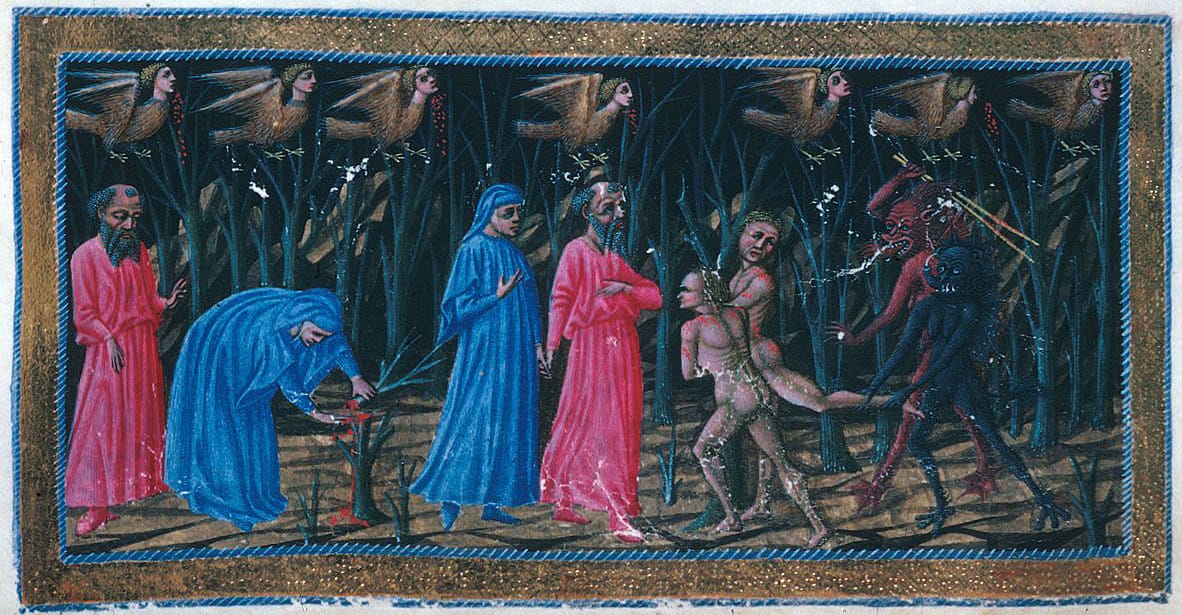
Virgil takes Dante by the hand and leads him to the broken bush. From it, blood seeps out, and with it, the voice of the soul trapped inside. The damned spirit lashes out at the squanderer who has just torn through him, blaming him for the pain and damage he’s caused.
Virgil gently asks the soul to reveal himself. Before speaking, the spirit begs the two poets to gather up his scattered branches at the foot of the bush. Then he explains that he is from Florence, a city that abandoned its old protector, Mars, for Saint John the Baptist, and for that reason is doomed to constant strife.
Only a surviving fragment of a statue of the ancient god along the Arno, he says, keeps the city from total destruction.
He ends his story with a quiet confession: he took his own life, hanging himself in his own home.
The canto abruptly ends here.
Conclusion
This canto is quite dense, both in writing style and content.
Suicide is a difficult topic to talk about, especially in Italy of the 14th century.
Through Pier della Vigna, the canto reveals how fragile the boundary can be between honour and ruin, hope and hopelessness. Dante does not excuse suicide, but he compels us to witness its cost not only as sin, but as suffering rooted in isolation and broken trust.
How do suicidal and depressive thoughts come about?
Mostly, when we think that the suffering we are going through will last as long as our life, or even outlive it!
It is indeed a distortion of one's perception of time, making it feel eternal, inescapable, and far greater than life itself.
This is actual and also deeply psychological on a Jungian level.
Pier della Vigna's story is everyone's, because in one way or another, we all have suffered loss and the collapse of the world around us.
Alighieri reminds us that this life is impermanent, everything we cherish we cannot bring with us, and the recognition of our divine nature (ultimately god) is not far from us.
Although mistakenly following material pleasures, we develop attachment, craving, and then grasping follows, hence desperation.
My question to you, my dear reader, is:
If you know that everything is impermanent (even yourself), why do you still act as if material possessions matter?
I hope you liked this Canto 13 analysis. I finished on a work trip to Nottingham and had the final inspiration after visiting Robin Hood's statue!
If you have any questions, please don’t hesitate to contact me via email or the comment section below.
As usual, find some useful links below and don’t forget to comment and subscribe!
Useful Links
 Antonello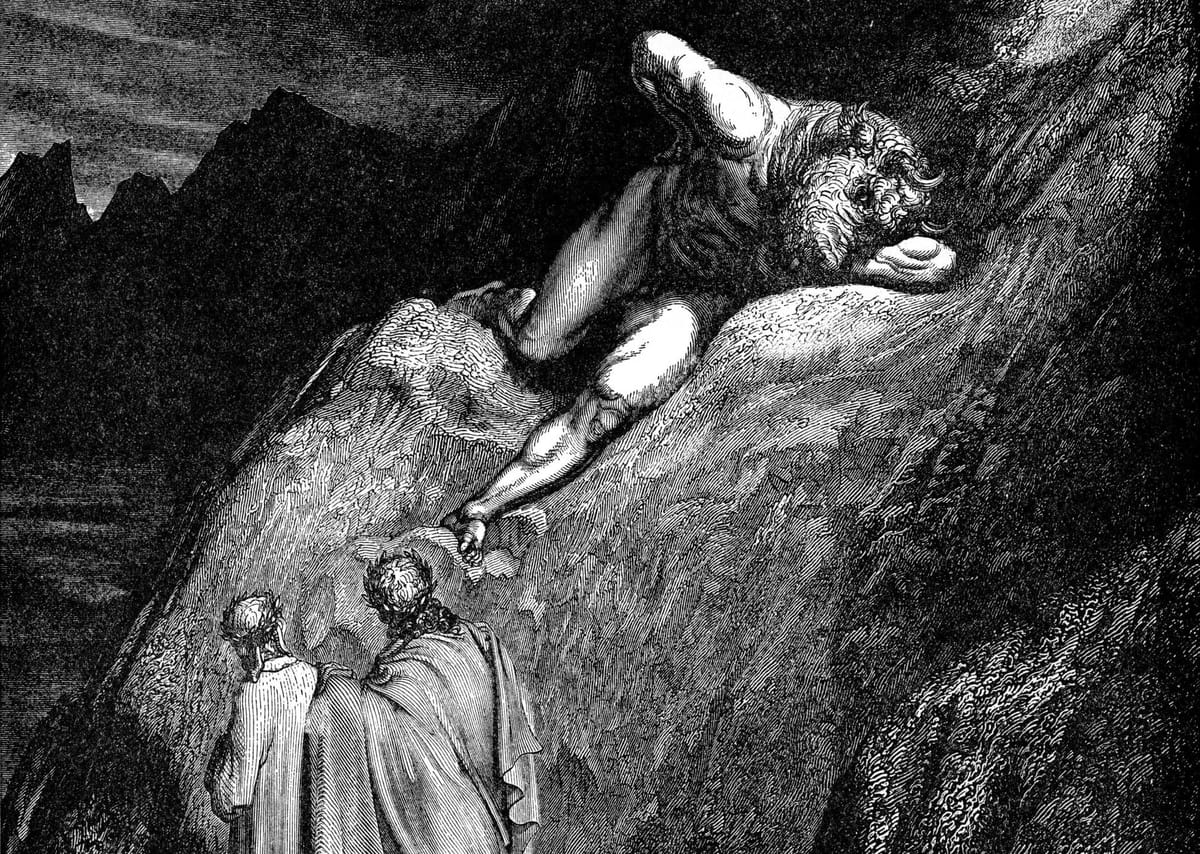
 Emily McLemore
 Contributors to Wikimedia projects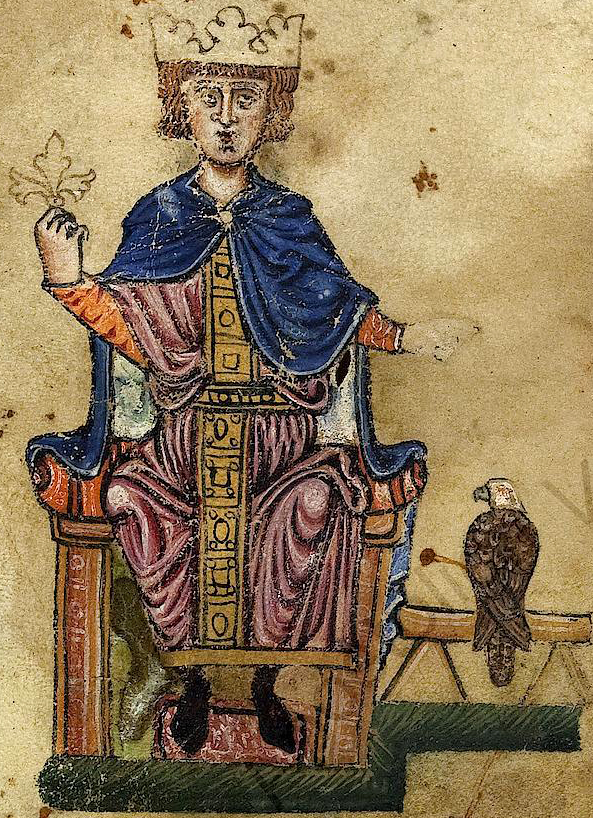
 Contributors to Wikimedia projects
 Contributors to Wikimedia projects